.jpeg)
The Honest Algorithm: AI, Authority, and the Art Market
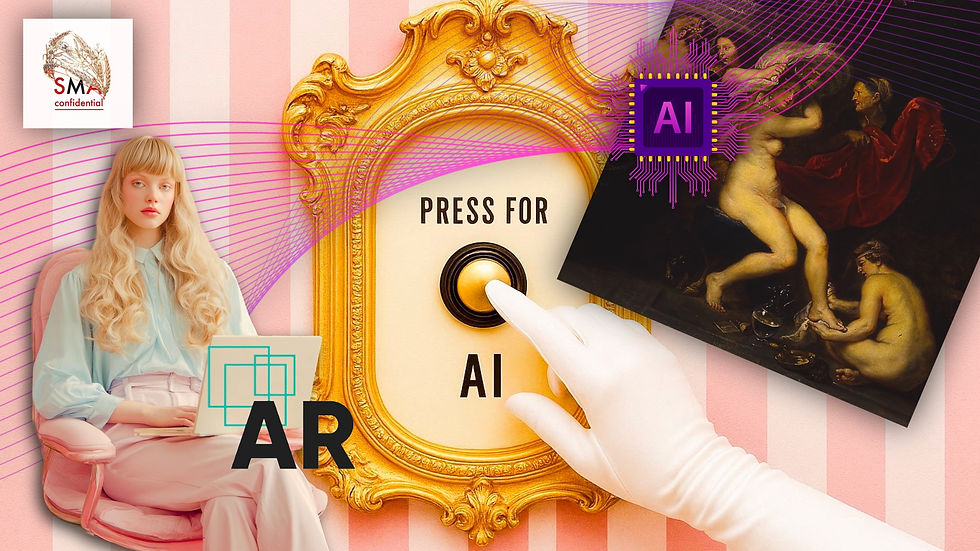
When an AI read a disputed Rubens patch by patch, it did something the art market could not abide — it told the truth about how little it knew. The contest that followed was never really about the algorithm. It was about who gets to decide what the algorithm’s findings mean, and in whose interest.
In the spring of 2026, at the Art Business Conference in Maastricht, a Swiss company called Art Recognition presented an analysis of a painting known as The Bath of Diana. Dated to around 1635, the work had long been catalogued as a copy of a lost Rubens. The company’s artificial intelligence was not asked the question the market usually asks — whether the picture is real. It was asked something more granular. It divided the canvas into twenty-nine sections and assessed each one independently. Ten returned as authentic with a probability above eighty per cent. Four returned as inauthentic. Seven were inconclusive. The rest sat in the uncertain middle.
What is striking about that result is not its confidence but its candour. The algorithm did not deliver a verdict. It delivered a distribution — a map of its own certainty and doubt, section by section, declining to round the picture up to a clean yes or down to a clean no.
Then a scholar disagreed. Nils Büttner, chairman of the Centrum Rubenianum in Antwerp and one of the foremost living authorities on the artist, disputed the attribution on grounds of connoisseurship. The disagreement was reported, argued over, and remains unsettled. The natural way to tell this story — the way much of the trade press told it — is as a duel between algorithm and expert: can AI really authenticate a Rubens, and should anyone believe it when a great scholar says no?
That is the wrong question. Answering the right one means looking past the painting to the company that built the algorithm, and past it to the people deciding what its findings would be taken to mean. Because the most revealing thing in this episode is not what the AI did. It is what was done with what the AI did.
What the algorithm got right
Begin with the part almost everyone skipped: the analysis was rather good.
Rubens did not work alone. He ran one of the largest and most productive workshops in the history of European art — a studio in which assistants, specialists and the master himself contributed to the same canvas: a hand here, a passage of drapery there, a head reserved for Rubens, the landscape left to another. For a great many pictures that passed through that studio, the question “is it a Rubens” has no clean answer, because the honest answer is “in part, and in places.” Authorship is genuinely distributed across the surface.
Which is precisely what the algorithm reported. A patch-by-patch probability map — some areas strongly autograph, some clearly not, much of it uncertain — is not an evasion. It is arguably a truer description of a workshop painting than any single verdict a connoisseur or a salesroom could issue. The distribution matched the object.
The trouble is that a distribution cannot be sold, insured, hung, or headlined. The market does not deal in “ten patches above eighty per cent.” It deals in attributions — Rubens or not-Rubens, the word that moves the price. And so the AI’s honest, untidy output had to be collapsed into something the market could use. The contest with Büttner did not happen over the distribution. It happened at the moment of collapse — the moment someone had to convert a map of probabilities into a single word. That collapse is not a technical act. It is an act of authority. And the question of who holds that authority is the real subject here.
The firm that built the lens
Art Recognition was founded in Zürich in 2019 by Dr Carina Popovici, a theoretical physicist who had worked as a quantitative risk analyst in Swiss banking, and Christiane Hoppe-Oehl, a mathematician she had met in that world. Their premise was stated plainly from the outset: the art market relied too heavily on the subjective judgement of human connoisseurs, and an algorithm could bring precision and impartiality where there had been intuition and interest.
That premise is itself a claim about authority before it is a claim about technology. It proposes to move the right to pronounce on a picture away from the scholar’s trained eye and toward the algorithm’s objectivity. It is a compelling pitch, and the company has pressed it on some of the most contested attributions in the field, from a Rembrandt in the Frick to works associated with Raphael and van Dyck. The technique is consistent: a neural network learns an artist’s hand from high-resolution images of authenticated works, set against negative examples — known forgeries, imitators, pupils, and even pictures generated by other AIs in the artist’s manner — and then assesses an unseen work against what it has learned.
But look at where the “objective” AI gets its idea of the truth.
The first moulding: at the point of input
A neural network knows only what it is taught. To learn Rubens, the model must first be shown which pictures genuinely are Rubens — and that ground truth has to come from somewhere. It comes from the catalogue raisonné: the scholarly inventory of an artist’s accepted work. The company has been candid about this. Where an artist has more than one competing catalogue — Modigliani notoriously has several, each admitting different pictures — the model is trained on whichever catalogue the market currently accepts.
Pause on what that means. The catalogue raisonné is the single most concentrated expression of human connoisseurial authority that exists. It is the accumulated verdict of exactly the scholars whose subjectivity the algorithm was built to transcend. Feed it in as ground truth and the AI does not escape that authority — it absorbs it, and reissues it in a more confident, more objective-sounding voice. The impartial instrument is the connoisseur’s judgement wearing a lab coat. It does not dissolve the old gate. It launders it.
This is the first place a neutral instrument is moulded by human interest: not through any flaw in the mathematics, but in the choice of what counts as truth before the mathematics begins.
The second moulding: at the point of output
The second is more visible, and it is the heart of the matter.
In November 2024, Art Recognition reached a milestone it was happy to announce loudly. Working with the Germann auction house in Zürich, it became the first to sell a work — a watercolour, for some seventeen thousand dollars — authenticated solely by AI. Popovici described the method as standalone, with humans curating the dataset but exercising, in her words, no human judgement in the actual evaluation. The framing was triumphant: until now, the argument ran, professionals had insisted art could only sell once a human connoisseur had vouched for it, and here was AI shaping a real transaction on its own authority.
Set beside that the company’s other voice. Interviewed only months earlier, the same founder had said that AI should not be relied upon alone, and that the future of authentication lay in collaboration between AI and human experts. And in November 2025, Art Recognition co-published, with a United States legal nonprofit, a Framework for Responsible Use of AI in Art Authentication, built on four principles — transparency, accountability, scientific rigour, and human–AI collaboration — the last of which makes non-solo use not an option but a stated norm.
So within a single year the same instrument is presented two ways. To the market, it is a standalone authenticator whose unaided verdict can carry a sale — because authority is what sells. To scholars and regulators, it is a careful assistant that must never act alone — because humility is what survives scrutiny. The output did not change. The authority attached to it was dialled up or down to suit the room. And the Maastricht presentation of the Rubens is simply the standalone, authoritative register walking into the trade’s own conference, and meeting — this time — a scholar willing to push back in public.
Why this is structural, not hypocritical
It would be unfair to read this as the inconsistency of one company or one founder. It is something more interesting: a structural condition of the seat itself.
Any commercial enterprise that builds an authentication tool is pulled toward both poles at once. To make a sale, it must claim that its findings mean something — that they carry weight, settle questions, justify a price. To survive, it must disclaim exactly that — because pronouncing on authenticity is financially lethal. The great artist authentication boards of the recent past — the committees for Warhol, for Basquiat, for Haring — did not dissolve because they lost the ability to judge. They dissolved because issuing verdicts invited ruinous litigation. The authority to pronounce became uninsurable, and the institutions that held it let it go.
The AI firms are now walking into that vacated seat. And the responsible-use frameworks, the guarantees “backed by a major insurer,” the careful language of collaboration — these are not only ethics. They are also an attempt to make the act of pronouncement insurable again, with the vendor occupying the seat the scholars abandoned. The oscillation between bold verdict and modest assistant is not a character flaw. It is the shape of the seat, and it would act on whoever sat in it.
Which returns us to the algorithm, and to the point that is easy to lose. The AI is neutral. It did something genuinely remarkable: it read a four-hundred-year-old surface and described, with disarming honesty, what it could and could not see. The distortions did not come from the instrument. They came from the human hands at either end of it — the verdict poured in as training truth, the authority dialled out to suit the audience. The neutral instrument sat in the middle, bracketed by interest. Left to itself, it told the truth. It was the field around it that could not afford to.
The position with nothing to dial
There is, in all of this, exactly one vantage point that is not subject to the pull — and it is worth naming precisely, because it is the position from which the whole episode becomes legible.
An instrument moulds its findings to interest when it has an interest to serve. The auction house has the hammer price. The advisor has the introductory commission. The platform has a subscription to renew and a transaction to facilitate. The authentication vendor has a sale to enable and a liability to manage. Each of them, for sound commercial reasons, must do something with a finding — collapse it, sharpen it, soften it, sell it. None of them can afford to leave a distribution as a distribution.
This is the precise space in which the Bespoke AI Art Intelligence Confidante is built to operate, and the logic of its design is the mirror image of everything above. It holds no inventory and earns no commission. No sale rides on its reading; no liability hangs on its restraint. It does not authenticate, does not value, and does not counsel on a work as an investment — not because it is timid, but because those are the very acts that pull every other player toward a verdict it has an interest in reaching. Having no such interest is exactly what frees it to do the one thing the market cannot: leave the honest, untidy distribution intact, and place the decision about what it means where it belongs — with the collector whose collection it is.
Read against the Rubens, the Confidante’s refusal to pronounce stops looking like caution about a new technology and starts looking like a deliberate decision not to do to a collector what the field does to itself. It will accompany a collector all the way to the edge of the question — what the attribution turns on, what the probabilities do and do not establish, what to ask the specialist, what the work would mean within the collection either way — and then it stops, because the collapse from map to verdict is the collector’s to make, and theirs alone.
The AI in Maastricht was the honest one in the room. The discipline worth building is the one that keeps it that way: an instrument with no interest to serve, handing the collector a clearer view and then letting them decide what they see. That is the difference between a tool that tells you what your picture is and a partner that helps you see it. In a market built to collapse every distribution into a price, the second is the rarer thing — and, increasingly, the more valuable.
Founder & CEO of SMA Crown Confidential
Digital Confidantes: Bespoke AI Intelligence for Private Decision-Makers
This article is part of an ongoing series by SMA Crown Confidential on the intersection of private wealth, cultural intelligence, and the future of bespoke AI.
Sources: Artnet News; The Art Newspaper; ARTnews; Robb Report; European Business Magazine; Art Recognition / Center for Art Law, Framework for Responsible Use of AI in Art Authentication (November 2025).


Comments