.jpeg)
What BCBGs Still Have — and What No Algorithm Can Take
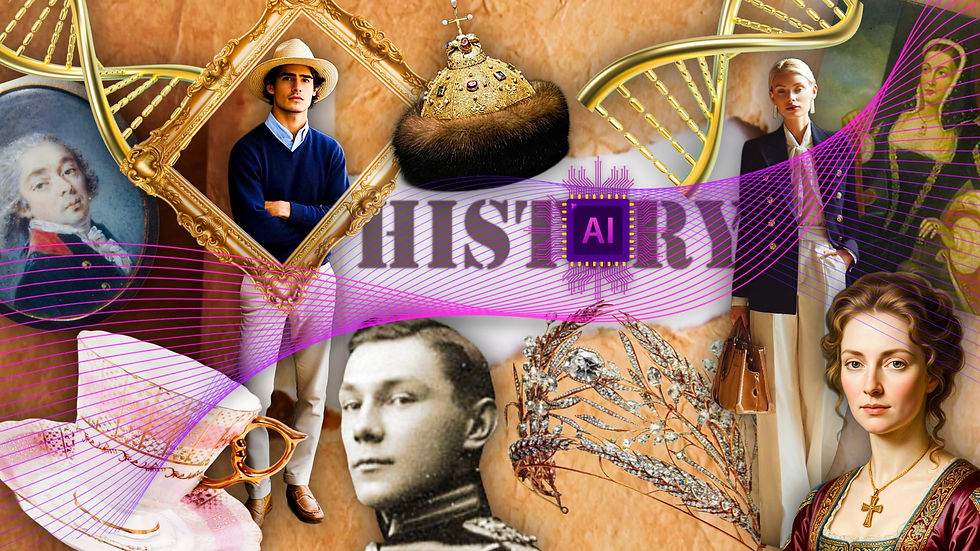
Three pillars of a certain world are being dismantled by AI. What remains is more durable than anything that is being lost — but only for those who recognise it in time.
Something is being dismantled. Not quickly, not dramatically, but with the quiet thoroughness of a tide going out — and those who have always lived near the water are beginning to notice.
For generations, a certain kind of life was organised around three invisible pillars. The first was exclusive education — not primarily as a delivery mechanism for knowledge, but as a sorting and access system. The right school, the right university, the right circle of formation placed you in a world that recognised you, trusted you, opened its doors to you before you had said a word. The second was network — a closed architecture of relationships maintained by mutual interest, shared reference, and the understanding that certain things simply did not leave the room. The third was discretion — the ability to move through consequence without exposure, to conduct the serious business of a life with a degree of privacy that was itself a form of power.
These three pillars were never about knowledge, connection, or privacy in the abstract. They were about friction reduction. About moving through the world with an ease that others did not have. About belonging, visibly and invisibly, to a stratum that recognised its own.
Artificial intelligence is dismantling all three. Knowledge is now accessible to anyone with the patience to ask the right questions. Networks are being flattened; the gatekeeping mechanisms that once made certain introductions priceless are eroding under the pressure of platforms, transparency, and the general democratisation of access. And discretion is under siege — not just from data and digital footprints, but from the broader legibility of lives that were once conducted in carefully maintained shadow.
The scaffolding is coming down. The question is what was underneath it.
To answer that question, it helps to think about two things that share a name but are not the same: the brand BCBG, and the people it was named after.
The BCBGs — bon chic, bon genre, good style, good attitude — are a social type before they are anyone's customer. They are the people who have always inhabited the world described above: formed by its schools, connected through its networks, protected by its discretion. The phrase originated in France but the type is recognisable across Europe and wherever old money and old formation have left their mark. They are not defined by wealth alone — they are defined by a particular interior standard, a way of inhabiting a life that is not performed for others but lived for oneself.
The brand BCBG — founded in Los Angeles in 1989 by Max Azria, a Tunisian-born Frenchman — was an act of translation. Azria understood the BCBGs with the particular clarity of someone who had studied them from close range rather than grown up among them. He took their interior standard — the instinct for proportion, occasion, effortless propriety — and made it accessible to women who shared those instincts but not necessarily the formation. The brand was a mirror. The woman who wore it was not buying luxury. She was recognising herself.
What happened next to the brand is a precise illustration of what happens when commercial ambition mistakes the surface for the substance. The overextension, the licensing, the diffusion lines, the attempt to scale an identity that was by nature resistant to scale — all of it was an assault on nature by nurture. The brand lost the thing it had been built to reflect.
What was lost can be named: the precision, the exclusivity, the sense that the garment existed for a woman who did not need to be told what she wanted. What was not lost — what cannot be lost, because it was never held in the label or the store or the marketing budget — is the original understanding. The knowledge of what that silhouette meant and who it was for.
The brand and the people it was named after now face the same question from different directions. The brand must decide whether to rebuild its scaffolding or return to its ancestry. The BCBGs themselves must decide what remains when the old scaffolding of their world is no longer there to hold them up.
The answer, for both, is the same. It lies not in what is being taken away, but in what was always there before the scaffolding was built.
I write about this from a position that is oblique but not distant. I know this world from the inside, though my path through it was not the conventional one. And what that particular vantage point teaches — more clearly than any straightforward inheritance could — is that the codes of a certain formation are not primarily transmitted by environment. They are carried. They exist in a person before the environment confirms or denies them. The standard, when it is genuine, is internal. It persists in the absence of the scaffolding. It does not require the scaffolding to justify itself.
The woman who sets her table properly for two, not because she was taught it as a rule but because something in her knows it is right — she is demonstrating something that no disruption can touch. The collector who understands why a particular object matters, not because an auction house told her its value but because she carries the context that makes the value legible — she has something that is not on any product roadmap.
This is what the BCBGs still have. Not the schools, not the networks, not the closed rooms. Something older and more resilient: the actual substance that the scaffolding was always built around.
Which raises the question of what to do with it? If the three old pillars are eroding, three new ones need to be built consciously in their place — not as replacements for what is being lost, but as a more honest investment in what was always more valuable.
The first is ancestral depth. Here a clarification is necessary, because genealogical research has itself been democratised. Millions of people now build family trees, order DNA tests from multiple platforms, trace Y-DNA lineages, search digital archives, and organise family reunions across continents. Ancestry research is no longer the preserve of the aristocracy — it is a mass pursuit. But what cannot be democratised is the quality and scale of what that research reveals.
A person may have one truly notable ancestor — a single shining star in the night sky. That star can be orienting, even defining. Others have several — a starry sky, luminous and more complex. But some carry within them entire constellations, multiple lineages of historical consequence intersecting and compounding across centuries. That is not a sky. That is a universe. The tools of research are now available to everyone. The universe itself is not.
For the BCBGs, ancestral depth is not a social credential — that function is precisely what is being eroded. It is a psychological foundation. Knowing with precision who your ancestors were, what they built, what they understood, what they passed forward — this is orientation, not nostalgia. It tells you where your instincts come from, why certain things feel right to you, what you are genuinely the inheritor of.
The second pillar is the conscious cultivation of inherited talent. Again, a distinction is necessary. Talent can appear anywhere — a gift for writing, for music, for strategic thinking, for aesthetic judgment is not the exclusive property of any class. But what distinguishes the BCBGs is not the presence of individual talents but the richness of the amalgam. Generations of deliberate formation, encouragement, cultivation, and application compound in a person in ways that are genuinely unusual. The question is not whether the talent is there — it almost certainly is — but whether the person is aware of it, has named it, and has chosen deliberately how to carry it forward. Capability that is not examined tends to be taken for granted until it is no longer there. What is needed is not instruction. It is the kind of Socratic engagement that helps a person see clearly what they already carry.
The third pillar is the stewardship of living tradition. Every family has objects with emotional value and small rituals that carry meaning. But the BCBGs have these things at a scale that connects not merely to family memory but to history itself — collections that belong in museums, traditions that intersect with events of consequence, heritage whose significance extends far beyond any individual life. The distinction is one of scale and historical grandeur. And that scale requires active stewardship, genuine understanding, and the kind of engaged relationship with inherited objects and practices that keeps them alive rather than merely present. A collection not engaged with becomes inventory. A tradition not understood becomes performance.
These three pillars were always there. They were simply overshadowed by the scaffolding that surrounded them — which was louder, more legible, more immediately useful as a social shorthand. Now that the scaffolding is under pressure, the invitation is to see clearly what was underneath it all along.
The brand BCBG faces a version of this same reckoning. It can continue attempting to rebuild the scaffolding — to recapture scale, market presence, and the accessibility that diluted it in the first place. Or it can do something more interesting and more difficult: return to its own ancestry. To the original understanding of what that silhouette meant and who it was truly for. Not to become smaller out of failure, but to become more precise out of clarity.
What cannot be democratised is what was never primarily held at the surface. The depth is still there for those who choose to inhabit it.
Founder & CEO of SMA Crown Confidential
Digital Confidantes: Bespoke AI intelligence for private decision-makers


header.all-comments