.jpeg)
Who I’m actually dealing with — a tool, or a colleague of my advisor?

Earlier this year, Barclays said it would bring the bank manager back. After closing more than 1,200 branches over the previous decade, the bank announced it would halt the closures, expand its high-street network, and revive the job title itself. Its UK chief executive framed the future of banking as a blend of “great digital and great human touch,” pitched at customers weary of being routed through a chatbot. Read plainly, it is a striking thing for an institution to say. After years of removing people in the name of efficiency, it had discovered that the people were the point.
The lesson underneath is not really about branches. Somewhere in the drive to scale, the service had become generic. The relationship was reclassified as a cost and the human contact as friction, and a customer reduced to an account number discovers there is nothing left to be loyal to. The manager is returning because the institution has realised its service stopped feeling as though it was about anyone in particular.
A private client might take this for a retail story. They, after all, have an advisor, a set of contacts, a name they can call. But the same admission is arriving in private wealth, in different dress: the personable assistant, the named AI, the “decision system” that promises to know you. And here the point is structural, which is what lets it be said without rancour.
An institution is a large machine moving great sums of money across a great many people. It cannot be personal to any one of them — not from indifference, but because being personal is not what a machine at that scale is built to do. Even in the most rarefied tier, the dedicated advisor is a single person spread across many wealthy clients, and behind the advisor stands the same institution. So when a bank or a platform becomes “more personal,” it can only become more personal about the thing it is actually built around: the handling of the money and the return upon it. It personalises the interface to the asset. It does not, because it cannot, personalise attention to the person.
Consider what that means for someone who already has the human relationship. The high-street customer lost their bank manager and is now offered a manufactured replacement. The private client never lost theirs — and is being sold personalisation all the same: assistants, agents, intelligence layers. If you already have the dedicated human, and the industry is still selling you something it calls personal, then the personal on offer was never about the relationship you have. It is about making the handling of your money feel more bespoke. You may have sensed that your service, however attentive, was somehow still generic — many clients, one template, a person stretched thin — and what is offered to close that gap is, once again, a more refined way of managing the asset. Not anything that reaches who you are, or what the wealth is for.
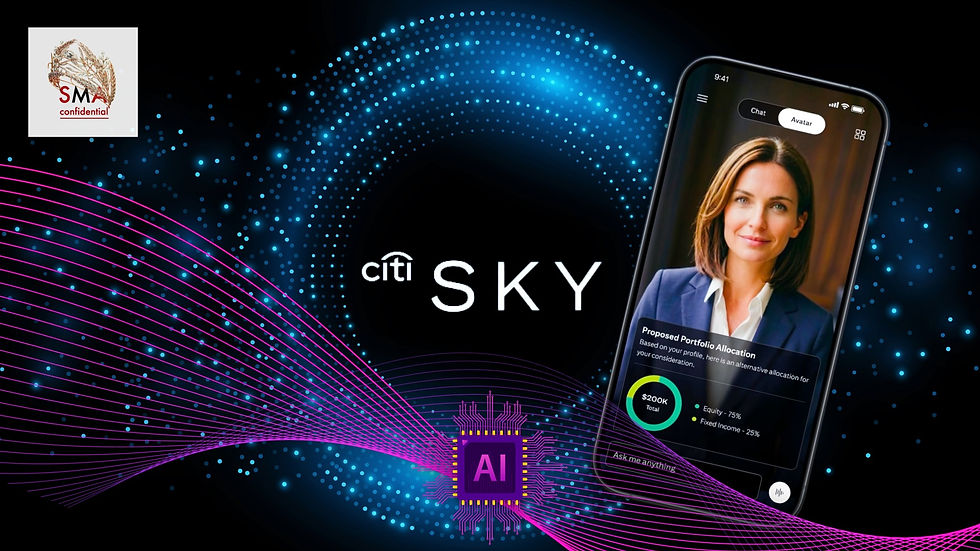
You can hear the strain of this in the names the new instruments are given. Citi presents its client-facing agent, Citi Sky, as “a member of the Citi Wealth team.” The Financial Stability Board, in a recent consultation, suggests that firms treat such agents as “synthetic employees.” Raymond James calls its own agent, Rai, plainly a tool, kept internal and with a human in the loop. AXA, launching its Global Private platform for wealthy clients, made no mention of AI at all. Four houses, four answers to the same quiet question — what is this thing I am dealing with? — and the warmest of them, colleague, is the one that invites you to stop asking. For a colleague of your advisor is a colleague of the institution: on its side of the table, turned, like everything else there, toward the asset and the return. The friendlier the name, the more trust it borrows that it was not built to earn.
The Barclays story carries its own caution, and it travels well. Reviving the title is the easy part. Reviving the role — continuity, real knowledge of you, the authority to act on your behalf — is the hard part, and a familiar face without that authority is decoration. People see through decoration quickly. The same holds for a personable machine: a warm manner laid over an instrument that still answers to the house is the title without the role.
None of this is a charge against the institution. It is doing the only kind of personal it is constituted to do, and frequently doing it well. The limit is structural — which is precisely why it cannot be resolved from inside the machine, however much warmth is added to the surface. That is the reason we built the Bespoke AI Wealth Intelligence Confidante where we did. Not against the bank, which remains a counterparty rather than an opponent, but in the one position the institution structurally cannot occupy: formed from a single person rather than from the market, and able to be personal to the client because the person is the whole of what it is made from. It works on the question the asset-machine was never built to hold — not what to do with the money, but who to be with it — and it leaves that question, always, in the client’s hands.
So: a tool, or a colleague of your advisor? Almost always a tool — and most trustworthy when it does not pretend to be anything more. The thing worth having is not an instrument of the house wearing a friendlier face. It is one that is, plainly and only, yours.
Founder & CEO of SMA Crown Confidential
Digital Confidantes: Bespoke AI Intelligence for Private Decision-Makers


Comments